
 Azerbaijan travel advice

Latest updates: Editorial change
Last updated: ET
On this page
- Risk level
- Safety and security
- Entry and exit requirements
- Health
- Laws and culture
- Natural disasters and climate
- Need help?
 Risk level
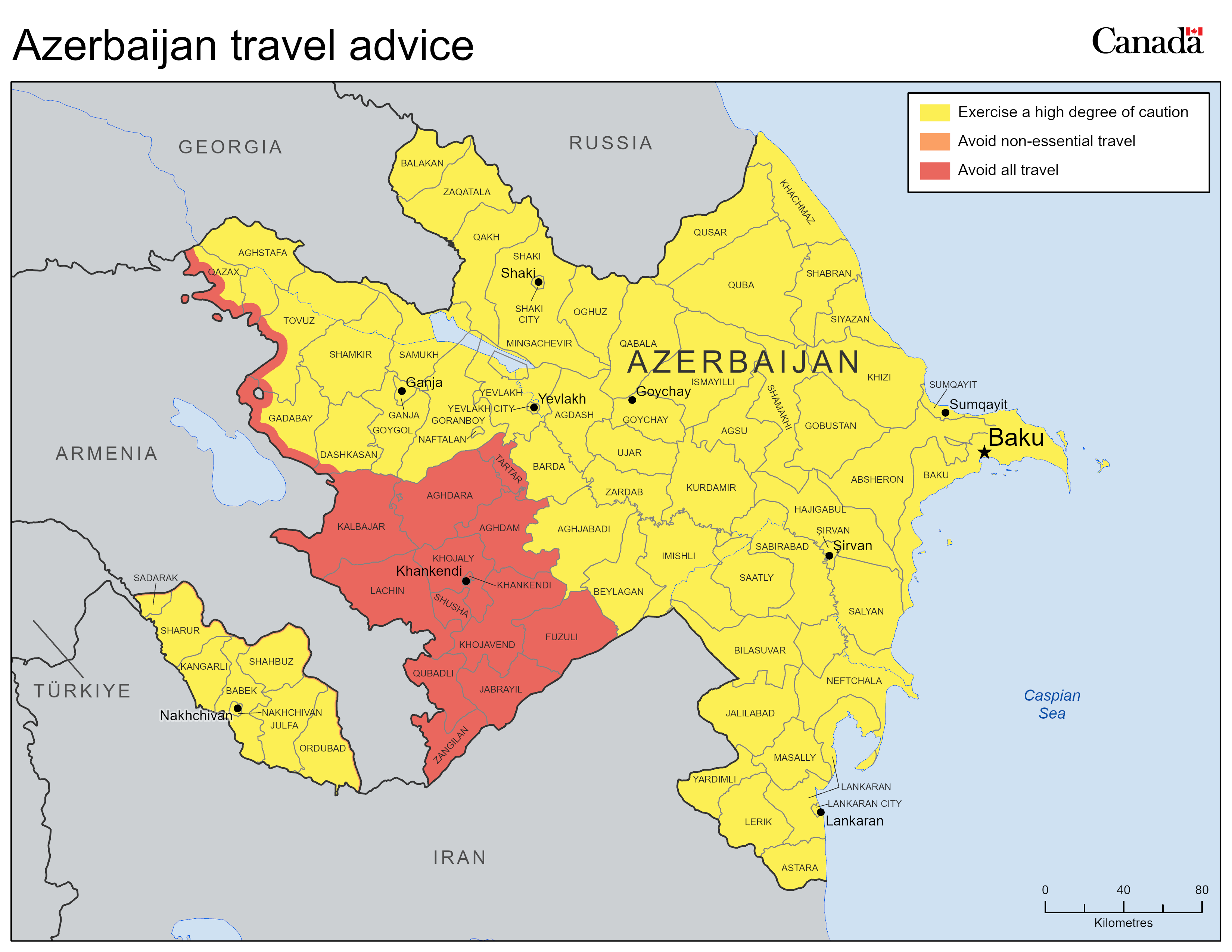
Disclaimer
The features in this map do not constitute an authoritative source of geographical information. This map is solely intended to assist Canadians by illustrating the risk levels contained in the Travel Advice and Advisories for this destination. The features in this map do not necessarily represent the views of the Canadian government on international boundaries, nomenclature or political status. The text under the Risk levels section takes precedence over this map.
Azerbaijan travel advice
Disclaimer
The features in this map do not constitute an authoritative source of geographical information. This map is solely intended to assist Canadians by illustrating the risk levels contained in the Travel Advice and Advisories for this destination. The features in this map do not necessarily represent the views of the Canadian government on international boundaries, nomenclature or political status. The text under the Risk levels section takes precedence over this map.
Azerbaijan - Exercise a high degree of caution
Exercise a high degree of caution in Azerbaijan due to the threat of terrorism.
Districts in the western part of Azerbaijan - Avoid all travel
Avoid all travel to the following districts due to the presence of unexploded ordnance:
- Aghdam
- Fuzuli
- Jabrayil
- Zangilan
- Gubadli
- Lachin
- Khojali
- Shusha
- Khankendi
- Khojavand
- Kalbajar
- Tartar
- Aghdara
The Government of Canada’s ability to provide emergency in-person consular services in these regions is extremely limited.
Border with Armenia - Avoid all travel
Avoid all travel to the area within 1 km of the border with Armenia, which is closed, due to the uncertain security environment.
This advisory excludes the border between Armenia and the Azerbaijani Autonomous Republic of Nakhchivan, where you should exercise a high degree of caution.
 Safety and security
Ongoing hostilities in the Middle East
There is ongoing military activity in the region. Missiles, drones and other projectiles could strike targets at any time.
There could be disruptions to air traffic, movement and transportation, including:
- flight cancellations
- airspace closures
The Astara land border crossing between Azerbaijan and Iran is closed. However, the Embassy of Canada to Türkiye, in Ankara, can request special entry authorization for Canadians from the Government of Azerbaijan.
If you assess that this is your safest option, contact the Embassy of Canada in Ankara or Global Affairs Canada’s 24/7 Emergency Watch and Response Centre. You must provide the details appearing on your Canadian passport’s bio page (full name, date of birth, document number) along with a photograph of the passport bio page. You must still apply for a visa from Azerbaijan authorities in advance.
You must have valid travel documents. If you have dual Canadian-Iranian citizenship, Iranian border officials may require you to present your Iranian passport, and if they do, they may prevent you from leaving Iran.
If you are denied departure by Iranian authorities, Canada is unable to communicate with them or intervene on your behalf.
You should:
- be vigilant and follow the instructions of local authorities at all times, including any orders to shelter in place
- ensure that your travel documents and those of your family are up to date
- monitor local and international media to stay informed of the rapidly evolving situation
- sign up with the Registration of Canadians Abroad service to receive important information, specific to your location, about the ongoing situation.
Districts in the western part of Azerbaijan
Despite clearing efforts by Azerbaijani authorities, unexploded ordnance continues to pose a risk in the western part of Azerbaijan.
You must have special travel permission from Azerbaijani authorities to enter certain areas in western Azerbaijan.
The Government of Canada’s ability to provide consular services in these regions is extremely limited.
If you decide to travel to districts in the western part of Azerbaijan despite the advisory in effect:
- be extremely vigilant in remote areas
- stay on paved and main roads
- do not walk in fields
- avoid roadside ditches, shoulders and unmarked trails
- pay attention to signs indicating the possible presence of unexploded ordnance
- report any suspicious items to local authorities
Unexploded Explosive Ordnance (UXO)
Borders
Border areas with Armenia
The Government of Canada’s ability to provide emergency in-person consular services in areas along the Armenia-Azerbaijan international borders is extremely limited.
The security environment remains uncertain along the Azerbaijan-Armenia border. While there have been no major incidents since September 2023, tensions remain high. Alleged ceasefire violations and accidents involving buried landmines have occurred. Security forces are deployed in the region, and access to the area is strictly controlled. Although the two countries have reached a peace agreement in principle, the process is ongoing and they are presently engaged in fully demarcating the border.
If you choose to travel near the border with Armenia despite the advisory in effect:
- exercise caution at all times
- avoid travelling at night
- monitor local and international media to stay informed on current clashes
- follow instructions from local authorities and security forces
Crime
Crime is relatively low. Most reported crimes involve burglary, assault or petty crime, such as pickpocketing, especially on public transportation.
Thieves sometimes pose as police officers and demand that tourists pay on-the-spot fines. If faced with this situation, offer to follow the officer to the nearest police station to pay the fine.
- Avoid walking alone after dark
- Be careful in areas that attract large crowds or that are very isolated or dimly lit
- Do not carry large sums of cash
- Avoid showing signs of affluence
- Keep your personal belongings, including your passport and other travel documents, in a secure place
Some women have reported incidents of unwanted male attention while walking alone or taking taxis.
Fraud
Credit and debit card as well as ATM fraud occurs.
When using your credit or debit card:
- cover the keypad with one hand when entering your PIN
- pay careful attention when others are handling your cards
- avoid using card readers with an irregular or unusual feature
- use ATMs located in well-lit public areas or inside a bank or business
- check for any unauthorized transactions on your account statements
If you’re travelling to Azerbaijan to meet someone you’ve only met online, you may be the victim of a scam.
Spiked food, drinks and other items
Never leave your food or drinks unattended or in the care of strangers. Avoid accepting snacks, beverages, gum or cigarettes from new acquaintances, as these items may contain drugs that could put you at risk of sexual assault and robbery.
Demonstrations
Demonstrations occur occasionally.
Even peaceful demonstrations can turn violent at any time. Police may use force to suppress demonstrations.
They can also lead to disruptions to traffic and public transportation.
- Avoid areas where demonstrations and large gatherings are taking place
- Follow the instructions of local authorities
- Monitor local media for information on ongoing demonstrations
Mass gatherings (large-scale events)
Terrorism
There is a threat of terrorism, especially in Baku. Terrorist attacks could occur at any time.
Targets could include:
- government buildings, including schools
- places of worship
- airports and other transportation hubs and networks
- public areas such as tourist attractions, restaurants, shopping centres, markets, hotels and other sites frequented by foreigners
Always be aware of your surroundings in public places.
Roads
Road conditions
Highways and major city roads are well-maintained, but driving can be dangerous due to:
- insufficient lighting and road signage, especially outside of Baku
- pedestrians and livestock on certain roads
Driving habits
Many drivers don’t pay attention to or disregard the speed limit, traffic rules and road signage. Local authorities don’t enforce traffic rules consistently.
In remote areas, fuel availability can be limited, and its quality may vary.
If you choose to drive in Azerbaijan:
- always drive defensively
- maintain distance from other vehicles on the road
- familiarize yourself with your route before you leave
- always carry a cell phone and charger
- keep a list of emergency numbers on hand
Public transportation
Buses are poorly maintained, often overcrowded and unsafe, particularly outside of Baku. Baku Metro is reasonably maintained and has basic safety equipment. Expect security cameras on and near the platforms and a police presence at each metro station, especially at night.
Only use reputable and officially marked taxis which are metered, or one of the available ride-sharing applications. Check that the vehicle has working seatbelts.
If you must travel by train, store personal belongings in a safe place and do not leave your compartment unattended. Ensure the door is secured from the inside.
Air travel
We don't make assessments on the compliance of foreign domestic airlines with international safety standards.
 Entry and exit requirements
Land border closures
Due to the extension of COVID-19 border measures since 2020, all land border crossings are closed, except for freight.
Canadian passport holders can only enter Azerbaijan by air, but may leave through land borders without seeking prior authorization.
Some countries have imposed measures in response to the Ebola disease outbreak. These can include restrictions on entry and health screening measures for travellers having recently visited an affected country. If you are suspected of having symptoms, you may be subject to isolation, quarantine and/or travel restrictions. Contact the authorities of the country you are travelling to for more details.
The authorities of a country or territory decide who can enter or exit through its borders. The Government of Canada cannot intervene on your behalf if you do not meet your destination’s entry or exit requirements.
We have obtained the information on this page from local authorities. It can, however, change at any time.
Verify this information with the Foreign Representatives in Canada.
Passport
Entry requirements vary depending on the type of passport you're travelling with.
Before you travel, check with your transportation company about passport requirements. Its rules on passport validity may be more stringent than the country's entry rules.
Regular Canadian passport
Your passport must be valid for at least 6 months beyond the date you arrive in Azerbaijan and have at least 2 blank pages for entry stamps. As a resident, your passport must be valid for at least 3 months beyond the expiry date of your temporary or permanent residence permit.
Passport for official travel
Different entry rules may apply.
Passport with “X” gender identifier
While the Government of Canada issues passports with an “X” gender identifier, it cannot guarantee your entry or transit through other countries. You might face entry restrictions in countries that do not recognize the “X” gender identifier. Before you leave, verify this information with the closest foreign representative for your destination.
You should also be aware that current systems used by some countries and travel companies may not recognize the “X” gender identifier. You may still be asked to provide your sex/gender information as either male or female when travelling.
Other travel documents
Different entry rules may apply when travelling with a temporary passport or an emergency travel document. Before you leave, verify this information with the closest foreign representative for your destination.
Useful links
- Travel and your sexual orientation, gender identity, gender expression and sex characteristics
- Foreign Representatives in Canada
- Canadian passports and other travel documents
Visas
Canadians must have a visa to visit Azerbaijan.
Tourist visa: required
Business visa: required
Student visa: required
Transit visa: required
If you plan to visit Azerbaijan, you must obtain a visa before arriving in the country. Canadian passport holders may apply for a tourist e-visa through Azerbaijan’s online visa portal and should do so at least 3 working days before their arrival in Azerbaijan.
E-visas are single-entry and are valid for 30 days. If you require any other type of visa, you must apply for it at the Embassy of the Republic of Azerbaijan prior to departure.
To obtain any type of visa, you must present a letter of invitation from a contact in Azerbaijan, such as an employer or educational institution. If you don’t have a contact there, the invitation letter should be submitted by your travel agency in Azerbaijan.
If you do not comply with visa or permit requirements, you may be fined, deported and barred from re-entering Azerbaijan.
Official electronic visa portal – Republic of Azerbaijan
Registration
If you intend to stay in Azerbaijan for more than 15 days, you must register with the State Migration Service within 15 calendar days of arrival. Ensure that your passport bears an entry stamp.
Failure to register could result in a fine. You may be prevented from leaving Azerbaijan until the fine is paid.
If you intend to stay in Azerbaijan for more than 30 days, you must obtain a temporary residence card or apply to extend your visa.
Registration – State Migration Service of the Republic of Azerbaijan
Districts in the western part of Azerbaijan
You may need to obtain prior authorization from the Azerbaijani authorities to enter and/or exit certain districts in the western part Azerbaijan. You should contact the nearest embassy or consulate of Azerbaijan before you travel.
Persons with disabilities
Expect accessibility to be limited in transportation, lodging, and general infrastructure.
Children and travel
Learn about travelling with children.
Yellow fever
Learn about potential entry requirements related to yellow fever (vaccines section).
 Health
Relevant Travel Health Notices
This section has information and advice about health risks you might face when travelling. Following this advice can help reduce your risk of getting sick. Not all risks are listed here.
It's best to talk to a healthcare provider or visit a travel health clinic preferably 6 weeks before your trip to get personalized health advice. Even if your travel date is coming up soon, it's still worthwhile to make an appointment.
Routine vaccines
Make sure your routine vaccinations are up-to-date before you travel, no matter where you’re going.
These may include vaccines for measles, mumps, and rubella (MMR), diphtheria, tetanus, pertussis (whooping cough), polio, varicella (chickenpox), meningococcal disease, seasonal flu, and others.
Provincial and Territorial Immunization Information
Pre-travel vaccines and medications
When travelling in this destination, you might be at risk for diseases that can be prevented with vaccines or medications. Talk to a travel health care provider about which ones are right for you based on your travel plans.
The highlights below will also tell you if your destination may require that vaccine for entering or exiting.
Yellow Fever - Country Entry Requirements
Yellow fever is a disease caused by a flavivirus from the bite of an infected mosquito.
Travellers get vaccinated either because it is required to enter a country or because it is recommended for their protection.
Risk
- There is no risk of yellow fever in this country.
Country Entry Requirement*
- Proof of vaccination is not required to enter this country.
Recommendation
- Vaccination is not recommended.
* It is important to note that country entry requirements may not reflect your risk of yellow fever at your destination. It is recommended that you contact the nearest diplomatic or consular office of the destination(s) you will be visiting to verify any additional entry requirements.
Hepatitis A
There is a risk of hepatitis A in this destination. It is a disease of the liver. People can get hepatitis A if they ingest contaminated food or water, eat foods prepared by an infectious person, or if they have close physical contact (such as oral-anal sex) with an infectious person, although casual contact among people does not spread the virus.
Practise safe food and water precautions and wash your hands often. Vaccination is recommended for all travellers to areas where hepatitis A is present.
Hepatitis B
Hepatitis B is a risk in every destination. It is a viral liver disease that is easily transmitted from one person to another through exposure to blood and body fluids containing the hepatitis B virus. Travellers who may be exposed to blood or other bodily fluids (e.g., through sexual contact, medical treatment, sharing needles, tattooing, acupuncture or occupational exposure) are at higher risk of getting hepatitis B.
Hepatitis B vaccination is recommended for all travellers. Prevent hepatitis B infection by practicing safe sex, only using new and sterile drug equipment, and only getting tattoos and piercings in settings that follow public health regulations and standards.
Measles
Measles is a serious viral infection that spreads easily. It spreads through the air, and can stay in the air for up to 2 hours. You can also get measles by direct contact with an infected person or by touching a surface with the virus on it and then touching your eyes, nose, or mouth before washing your hands.
Getting vaccinated is the best way to protect yourself and others from measles. In Canada, the measles vaccine is part of the routine immunization schedule. If you’re unsure whether you’re protected, talk to a healthcare provider.
Learn more:
COVID-19
COVID-19 is an infectious viral disease. Most of the time, it spreads when people are in close contact with others who are infected with the virus. It spreads through respiratory particles, or through an infected surface or object.
Vaccination is one of the most important ways to protect yourself from developing serious complications from COVID-19. Talk to a healthcare provider about the COVID-19 vaccine before travelling. Evidence shows that the COVID-19 vaccines used in Canada are very effective at preventing severe illness, hospitalization and death from COVID-19.
In addition to vaccination, use personal protective measures to help protect yourself and others.
Learn more :
Vaccine for COVID-19: How to get vaccinated
COVID-19: Spread, prevention and risks
Influenza
The best way to protect yourself from seasonal influenza (flu) is to get vaccinated every year. Get the flu shot at least 2 weeks before travelling.
The flu occurs worldwide.
- In the Northern Hemisphere, the flu season usually runs from November to April.
- In the Southern Hemisphere, the flu season usually runs between April and October.
- In the tropics, there is flu activity year round.
The flu vaccine available in one hemisphere may only offer partial protection against the flu in the other hemisphere.
The flu virus spreads from person to person when they cough or sneeze or by touching objects and surfaces that have been contaminated with the virus. Clean your hands often and wear a mask if you have a fever or respiratory symptoms.
Rabies
Rabies is common in this destination and is carried by dogs and some wildlife, including bats. Rabies is a serious disease that’s almost always fatal once symptoms appear. It's spread to humans through the saliva of infected animals, mainly through bites, but it can also be spread through scratches.
Before you travel, talk to a health care professional about rabies vaccination. Vaccination may be recommended, particularly for people at higher risk of exposure, such as:
- veterinarians and wildlife workers
- children
- adventure travellers and cave explorers (spelunkers)
- people who will be in close contact with animals
While travelling:
- avoid contact with animals, especially dogs
- supervise children closely around animals
If you’re bitten or scratched by an animal:
- wash the wound right away with soap and clean water for about 15 minutes
- get medical care as soon as possible
In this destination, treatment to prevent rabies may be limited or not available. You may need to travel to another location to receive treatment.
If you get treatment to prevent rabies while outside Canada, ask for:
- written records of medications and vaccines administered, including when they were given, product names, and batch or lot numbers
- photos of the packaging and labels of any medications or vaccines given to you
When you return to Canada, see a health care professional as soon as possible and bring your treatment records to your appointment.
Learn more:
Rabies: Symptoms and treatment
Safe food and water precautions
Eating or drinking unsafe food or water, or swimming in contaminated water can make you sick while travelling. Take precautions by following these tips:
- Boil it, cook it, peel it, or leave it (only eat food that is prepared safely)
- Avoid, if possible, getting water in your eyes, mouth, or nose when swimming in freshwater (like streams, lakes, or canals), especially after heavy rain or flooding - the water might look clean but can still be contaminated
- Don’t swallow water when bathing, showering, swimming in pools, or using hot tubs
Travellers' diarrhea
Travellers' diarrhea is the most common illness that affects travellers. Travellers are at higher risk when going to destinations with poor standards of hygiene and sanitation and/or eating at places with poor food handling practices. Young children, the elderly, and people with existing health problems are more at risk.
Travellers’ diarrhea is caused by many different bacteria, viruses, and parasites. It’s easily spread from person-to-person or by consuming contaminated food or water. Besides diarrhea, symptoms usually include fever, nausea, vomiting, and stomach pain.
Frequent handwashing and making careful food and beverage choices can reduce your risk of developing travellers’ diarrhea. If you become sick, the most important thing to do is to maintain hydration by drinking lots of fluids.
Learn more:
Travellers’ diarrhea
Eat and drink safely outside Canada
Tick and insect bite prevention
Many diseases are spread by bites from infected ticks and insects like mosquitoes, fleas, or flies. Before you travel, find out what types of ticks or insects are in the area, when they’re most active, and what diseases they can spread.
To protect yourself from bites:
- use an approved bug spray (insect repellent) on exposed skin
- wear light-coloured, loose clothing made of tightly woven materials like nylon or polyester
- wear socks and closed-toe shoes
- sleep under mosquito netting if you’re outdoors or staying in places that aren’t fully enclosed
- do a full body tick check on yourself, your children, your gear, and any pets you’re travelling with when you return from outdoor activities
Insect bite and pest prevention
Personal insect repellents
Animal precautions
Some infections can spread directly from animals to people, like rabies or bird flu (avian influenza). Others don’t spread directly from animals but can infect people who visit areas animals have contaminated with their droppings or body fluids.
Certain activities can increase your chances of coming into contact with animals, their droppings, or their body fluids, like:
- travelling in rural or forested areas
- camping, hiking, or visiting caves
- visiting places where live animals are sold or killed for food, like wet markets
To reduce your risk of getting sick:
- avoid contact with animals like stray dogs, livestock (such as pigs and cows), monkeys, snakes, rodents, birds, and bats.
- stay away from places where animal waste can build up, such as caves
- avoid eating undercooked meat
Make sure to closely watch children; they are more likely to try to touch animals.
Avian Influenza
Human cases of avian influenza have been reported in this destination. Avian influenza is a viral infection that can spread quickly and easily among birds and in rare cases it can infect mammals, including people. The risk is low for most travellers.
Avoid contact with birds, including wild, farm, and backyard birds (alive or dead) and surfaces that may have bird droppings on them. Ensure all poultry dishes, including eggs and wild game, are properly cooked.
Travellers with a higher risk of exposure include those:
- visiting live bird/animal markets or poultry farms
- working with poultry (such as chickens, turkeys, domestic ducks)
- hunting, de-feathering, field dressing and butchering wild birds and wild mammals
- working with wild birds for activities such as research, conservation, or rehabilitation
- working with wild mammals, especially those that eat wild birds (e.g., foxes)
All eligible people are encouraged to get the seasonal influenza shot, which will protect them against human influenza viruses. While the seasonal influenza shot does not prevent infection with avian influenza, it can reduce the chance of getting sick with human and avian influenza viruses at the same time.
Person-to-person infections
When travelling, you can reduce your risk of getting or spreading respiratory infections, like the flu or COVID-19, by:
- staying at your accommodation and limiting contact with others if you’re sick
- wearing a well-fitting mask, especially:
- if you’re sick and need to be around others
- when you’re at large indoor events or in crowded settings, like sporting events, concerts, and airports
- cleaning your hands regularly with soap and water for at least 20 seconds, or using hand sanitizer containing at least 60% alcohol
- covering your coughs and sneezes with a tissue or your elbow, not your hands
Mass gatherings (large-scale events)
Clean your hands to help reduce the spread of infectious diseases
Respiratory infectious diseases: How to reduce the spread with personal protective measures
To lower your risk of getting sexually transmissible infections (STIs), HIV, and mpox, you can:
- get vaccinated against mpox if you’re eligible
- practise safer sex methods
- use barrier protection during sexual activity, like condoms and dental dams.
Mpox vaccines
Sexual health and travel
HIV and AIDS: Travel health advice
Tuberculosis
Tuberculosis is an infection caused by bacteria and usually affects the lungs.
For most travellers the risk of tuberculosis is low.
Travellers who may be at high risk while travelling in regions with risk of tuberculosis should discuss pre- and post-travel options with a health care professional.
High-risk travellers include those visiting or working in prisons, refugee camps, homeless shelters, or hospitals, or travellers visiting friends and relatives.
Medical services and facilities
Good health care is generally only available in major cities, particularly in Baku. Medical facilities outside the capital are very limited.
Private hospitals are usually better equipped than public ones but typically require advance payment or a financial guarantee before providing treatment. Credit card payments are not always accepted. Before agreeing to care, confirm billing arrangements, costs, and proposed medical procedures. Medical staff may speak little or no English, and legal recourse in cases of malpractice is very limited in Azerbaijan.
Avoid older medical clinics, which often lack basic medications and equipment and may have poor hygiene standards. Some facilities require upfront cash payment.
Medical evacuation can be very expensive and you may need it in case of serious illness or injury.
Make sure you get travel insurance that includes coverage for medical evacuation and hospital stays.
Health and safety outside Canada
Medication
Some prescription medications may not be available in Azerbaijan.
If you take prescription medications, you’re responsible for determining their legality in Azerbaijan.
- Bring enough medication for your stay
- Always keep your medication in the original container and carry a copy of your prescriptions
- Pack your medication in your carry-on luggage
Keep in Mind...
The decision to travel is the sole responsibility of the traveller. The traveller is also responsible for his or her own personal safety.
Be prepared. Do not expect medical services to be the same as in Canada. Pack a travel health kit, especially if you will be travelling away from major city centres.
 Laws and culture
You must abide by local laws.
Learn about what you should do and how we can help if you are arrested or detained abroad.
Illegal or restricted activities
It is strictly forbidden to take pictures of military installations and equipment. Trespassing on military sites can lead to arrest. Visitors have been detained and questioned when attempting to photograph military bases, equipment and installations, all of which are considered sensitive.
Promoting religion and trying to convert others are not permitted.
Identification
Always carry your passport. Keep a photocopy of your passport in a safe place in case it’s lost or confiscated.
If you are a resident, you must provide proof of residency status.
Police checks in public areas are common. You could be taken to a police station and fined if you fail to provide proper identification on request from an official.
Drugs
Penalties for possession, use or trafficking of illegal drugs are severe. Convicted offenders can expect long jail sentences and heavy fines.
2SLGBTQI+ persons
Azerbaijani law does not prohibit sexual acts between individuals of the same sex. However, 2SLGBTQI+ persons may face discrimination, harassment, and violence based on their sexual orientation, gender identity, gender expression, or sex characteristics.
Travel and your sexual orientation, gender identity, gender expression and sex characteristics
Dual citizenship
Azerbaijan doesn’t legally recognize dual citizenship for adults (aged 18 or older).
If local authorities consider you a citizen of Azerbaijan, they may refuse to grant you access to Canadian consular services. This will prevent us from providing you with those services.
A citizen of Azerbaijan who acquires foreign citizenship must notify Azerbaijani authorities in writing within one month. If you are in Azerbaijan, you should contact the State Migration Service. If you are outside the country, you should contact the Ministry of Foreign Affairs of Azerbaijan or an Azerbaijani diplomatic mission accredited in your country of residence.
If you hold a Canadian passport and have ties to Azerbaijan, by birth or otherwise, and are unsure of your Azerbaijani citizenship status, you should contact the State Migration Service before travelling. Canadians with Azerbaijani citizenship may be subject to national obligations, such as taxes and military service.
Military service is mandatory for Azerbaijani male citizens between the ages of 18 and 30. If you have not completed your military service, you could face fines or arrest and could be prevented from departing Azerbaijan on your Canadian or Azerbaijani passport until you meet the military service requirements.
Useful links
- Information on military service – State Service for Mobilization and Conscription (Azerbaijani only)
- Dual citizens
International Child Abduction
The Hague Convention on the Civil Aspects of International Child Abduction is an international treaty. It can help parents with the return of children who have been removed to or retained in certain countries in violation of custody rights. It does not apply between Canada and Azerbaijan.
If your child was wrongfully taken to, or is being held in Azerbaijan by an abducting parent:
- act as quickly as you can
- consult a lawyer in Canada and in Azerbaijan to explore all the legal options for the return of your child
- report the situation to the nearest Canadian government office abroad or to Global Affairs Canada by calling the Emergency Watch and Response Centre
If your child was removed from a country other than Canada, consult a lawyer to determine if The Hague Convention applies.
Be aware that Canadian consular officials cannot interfere in private legal matters or in another country's judicial affairs.
Useful links
- International Child Abductions: A guide for affected parents
- Children and travel
- Canadian embassies and consulates by destination
- Request emergency assistance
Driving
You must carry an International Driving Permit.
There is a zero-tolerance policy for drinking and driving.
Traffic stops are common. Always carry your licence, International Driving Permit, proof of insurance and vehicle registration.
You must have the following documents in the car:
- vehicle registration
- your passport and driver’s licence
- proof of insurance
- first aid kit
- check-up card (proof that the vehicle is roadworthy)
If you intend to drive for more than one month, you may need to convert your Canadian driver’s licence into an Azerbaijani one.
If you own a car, you must get an annual roadworthiness test done between January 1 and October 31. You will receive a check-up card each year following the inspection.
Azerbaijan Service and Assessment Network
Imports and exports
You must declare foreign currency upon entry. You cannot leave the country with more than you brought in.
There are restrictions on the import and export of certain goods to and from Azerbaijan. Customs authorities strictly enforce regulations concerning the import and export of firearms, religious objects, works of art and antiquities.
You need an export certificate to take antiques or art like carpets, samovars, copperware or paintings out of Azerbaijan. Your can get a certificate from your vendor or the Azerbaijan National Carpet Museum.
Useful links
- Prohibition and restrictions – State Customs Committee of the Republic of Azerbaijan
- Azerbaijan National Carpet Museum
Mobile devices
If you plan to use a local SIM card for more than 30 days, you must register it and pay a fee at a local post office. If you don’t declare your device or register your SIM card, it may stop working on local networks.
Dress and behaviour
Azerbaijan is a secular state, but some people adhere closely to Islamic practices and beliefs.
To avoid offending local sensitivities:
- behave discreetly
- respect religious and social traditions
In 2027, the lunar month of Ramadan is expected to begin on or around February 7.
In public, between sunrise and sunset, be discreet when:
- drinking
- eating
- smoking
Money
The currency of Azerbaijan is the Azerbaijani manat (AZN).
Outside of major businesses, credit cards may not always be accepted for payment.
Several ATMs in major cities dispense both U.S. dollars and Azerbaijani manat.
 Natural disasters and climate
Earthquakes
Azerbaijan is located in an active seismic zone.
Seismic alerts – Republican Seismic Survey Center of the Azerbaijan National Academy of Sciences
Flooding and landslides
Flooding may occur in parts of Azerbaijan, especially on the Southern Caspian coast in the Lankaran-Astara region. Heavy rains can overwhelm drainage systems in urban centres, including Baku, and increase the risk of flash flooding. They can hamper overland travel and reduce the provision of essential services. Landslides could occur, making roads impassable and damaging infrastructure.
- Monitor local media for the latest information, including on road conditions
- Stay away from flooded areas
- Monitor weather reports
- Follow the instructions of local authorities, including evacuation orders
 Need help?
Local services
Emergency services
In case of emergency, dial:
- police: 102
- medical assistance: 103
- firefighters: 101
The Police Office of Crimes By and Against Foreigners offers service in English. You can reach the office at +944 12 590 9966.
Consular assistance
There is no office of the Government of Canada in Azerbaijan.
During business hours: contact the office nearest to you.
For emergency assistance at any time: contact the Emergency Watch and Response Centre in Ottawa.
Ankara - Embassy of Canada
Azerbaijan, Georgia. Offering consular services to Canadians in Iran.
Appointment Book your appointment online
Disclaimer
The decision to travel is your choice and you are responsible for your personal safety abroad. We take the safety and security of Canadians abroad very seriously and provide credible and timely information in our Travel Advice to enable you to make well-informed decisions regarding your travel abroad.
The content on this page is provided for information only. While we make every effort to give you correct information, it is provided on an "as is" basis without warranty of any kind, expressed or implied. The Government of Canada does not assume responsibility and will not be liable for any damages in connection to the information provided.
If you need consular assistance while abroad, we will make every effort to help you. However, there may be constraints that will limit the ability of the Government of Canada to provide services.
Learn more about consular services.
Risk Levels
 Take normal security precautions
Take similar precautions to those you would take in Canada.
 Exercise a high degree of caution
There are certain safety and security concerns or the situation could change quickly. Be very cautious at all times, monitor local media and follow the instructions of local authorities.
IMPORTANT:The two levels below are official Government of Canada Travel Advisories and are issued when the safety and security of Canadians travelling or living in the country or region may be at risk.
 Avoid non-essential travel
Your safety and security could be at risk. You should think about your need to travel to this country, territory or region based on family or business requirements, knowledge of or familiarity with the region, and other factors. If you are already there, think about whether you really need to be there. If you do not need to be there, you should think about leaving.
 Avoid all travel
You should not travel to this country, territory or region. Your personal safety and security are at great risk. If you are already there, you should think about leaving if it is safe to do so.
- Date modified: